
 You know the feeling. You stand up after a few hours at your desk and your hips feel locked. You reach for something on a high shelf and your shoulder catches. You finish a run and spend the next two days walking like you’ve aged twenty years overnight. None of this is dramatic enough to send you to A&E, but it adds up, and over time it starts shaping how you move through your day.
Why Mobility Restrictions Happen
Stiffness rarely appears overnight. More often, it develops gradually through muscle tension, posture, repetitive movement, and everyday habits. Sitting for long stretches, which, let’s be honest, describes most jobs now, can contribute to tightness around the hips, lower back, and shoulders. Repetitive activities, whether from training, manual work, or even how you sleep, can create imbalances where some muscles become overactive while others become less active.
It’s a gradual process, which is why so many people simply adapt to it instead of looking into what’s causing it.
How Massage Therapy Can Help
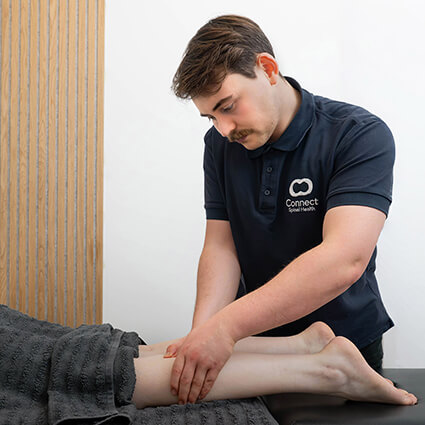
This is where massage earns its keep. Rather than focusing on relaxation alone, the aim is to improve movement. Targeted massage works on muscles and connective tissue that may be contributing to tightness or restricted movement, using techniques designed to ease muscle tension and improve tissue mobility.
The Chiropractic and Massage Combination
Massage and chiropractic care often complement one another, something we see regularly at Connect Spinal Health. Chiropractic care focuses on assessing and improving joint movement, while massage therapy works with the surrounding muscles and soft tissues. Because muscles and joints influence one another, many people choose to combine both approaches. Even when joints are moving well, tight muscles can still contribute to stiffness or restricted movement.
Stiffness can be easy to dismiss as part of getting older or simply part of the job, but restricted movement may have several contributing factors. Looking at the muscles alongside the joints can give us a clearer picture of what may be affecting movement, so we can recommend an approach suited to the individual.”
Dylan George, Sports Massage Therapist
When Stiffness Starts Getting in the Way
If stiffness or restricted movement has started to feel normal, it may be worth having it assessed. Whether it shows up after a day at your desk or following your usual training session, our Leith clinic is a straightforward place to start understanding what may be behind it.